Asphalt estate roads and car parks: patch, resurface or rebuild?
When an asphalt estate road or car park fails, patching, resurfacing and structural repair are not interchangeable. How to choose the right scope.
By Connor Lyons, Commercial director, MRICS
Generated by your browser's built-in AI. May not be fully accurate.
A failing asphalt car park forces a decision most estate managers end up making blind. The surface is breaking up, tenants are complaining, and three contractors have sent three quotes for three different jobs: local patching, a resurface and a full-depth rebuild. They cannot all be right, and picking the wrong one wastes the budget either way. Patch a pavement that has failed structurally and the defects return. Rebuild one that only needed surface renewal and you tie up capital unnecessarily.
The decision is not really about price, even though price is what the quotes put in front of you. It is about what has actually failed. This article is about flexible asphalt pavements, not concrete or block paving, and the actual treatment still has to follow investigation and design. Patching, resurfacing and structural rehabilitation answer different problems. Read the defect first and the correct scope, and the honest cost, follow from it.
Read the defect before you read the quote
A typical flexible pavement is built in layers: the asphalt surface course you drive on, binder and base courses beneath it, then a foundation that usually includes a sub-base and may include capping or ground improvement over the compacted subgrade. The exact build-up depends on the traffic, ground conditions and original design. Visible symptoms indicate where to investigate, but they do not prove which layer has failed.
- Potholes and localised cracking in an otherwise sound area may be confined to a weak surface or a failed reinstatement, but the cut-out still needs to expose and remove unsound material before the repair depth is fixed.
- Fine surface or block cracking away from the wheel paths can be associated with ageing, shrinkage or movement in the upper layers. The structure beneath may remain serviceable, but the pattern and depth need checking.
- Interconnected crocodile or fatigue cracking, particularly in wheel paths and alongside rutting, can indicate structural distress under repeated loading. It should not be treated as proof that only the surface course has worn out.
- Rutting and shoving, where wheel tracks sink or the surface ripples at turning points, can arise within the asphalt layers or lower in the foundation. A new surface alone is not a safe default until the source of the deformation is understood.
- Depressions, settlement and edges dropping away can point to failed support, weak or wet foundation material, utility reinstatements, tree roots or local subgrade movement. The cause and extent decide whether the repair is local or structural.
- Standing water and ponding accelerates deterioration and may also create an immediate safety problem. Check whether the cause is blocked drainage, damaged pipework, local settlement or inadequate surface falls.
A competent walk-round, ideally after rain so the drainage behaviour is visible, is the right first step. It can map defects, traffic routes, ponding and previous repairs far better than a quote produced from one photograph. It is still an initial diagnosis. The DfT’s guidance on manual visual road-condition surveys distinguishes surface defects from structural condition, while its structural-condition guidance explains how deflection testing, coring and ground-penetrating radar can supplement the visible evidence. On a private estate, proportionate investigation might mean records and a few targeted cores or trial pits rather than a network-scale survey, but widespread or uncertain structural defects should not be scoped by appearance alone.
The three options, and when each is right
Once you know how deep the failure goes, the choice between the three becomes much clearer.
Patching and localised repair is right when the defects are isolated and the pavement around them is sound. Cutting out a pothole or failed section, removing unsound material, treating the cause and reinstating the full repair depth is often the lowest-cost durable option for a car park that is otherwise healthy. Where it goes wrong is when patching is used to chase a pavement that is failing across whole zones: the same visits repeat, and a car park that is becoming more patch than original surface needs a wider condition review.
Resurfacing, renewing one or more asphalt layers after suitable preparation, is right when investigation shows that the retained structure and foundation remain serviceable. Typical candidates include widespread fretting, oxidation, loss of texture or shallow surface defects rather than uninvestigated fatigue cracking. Done properly, resurfacing can restore the running surface without the cost and disruption of full reconstruction. The critical judgement is what remains underneath: an overlay over a serviceable structure can perform well, while an overlay over unresolved structural movement or water ingress can fail prematurely.
Reconstruction or structural rehabilitation is needed when the base or foundation has failed, the subgrade has moved, or the existing build-up is inadequate for the traffic it now carries. The designed treatment may be local or full-depth reconstruction, foundation repair, stabilisation, a strengthening overlay or in-situ recycling, depending on the investigation and constraints. The DfT’s road-condition glossary distinguishes reconstruction, overlays and in-situ recycling as different treatment families. Structural work costs more and causes more disruption than surface renewal, so it should be targeted to the areas and depths that need it rather than assumed across the whole site.
Drainage is usually the real story
A common expensive mistake in car park repair is resurfacing without resolving a drainage problem. Water entering a pavement can weaken unbound foundation material and subgrade, contribute to loss of support and accelerate damage under traffic and freeze-thaw cycles. If a car park is ponding, the gullies are blocked or the falls no longer send water where they should go, the visible surface defect may be a symptom rather than the whole cause.
Lay a new surface over that and you have treated the symptom while leaving the cause in place. Unresolved water ingress can shorten the service life of the repair and allow defects to recur prematurely. Any serious repair decision has to include the drainage: whether the falls are still correct, whether the gullies and pipework work, and whether the water actually leaves the site. Getting the levels right so the surface drains, which our drainage gradients and falls reference sets out, is not a detail bolted on at the end. On many failing car parks it is part of the repair.
The cheapest quote is rarely the cheapest job
Estate budgets are tight and the temptation is to take the lowest number and move on. The problem is that a low initial price can buy a short service life if the scope does not address the cause, and on a car park the whole-life cost matters alongside the invoice this year.
Patching a structurally failed pavement is the clearest example. Each visit may be affordable in isolation, but repeated repairs can overtake the cost of one properly scoped intervention. The reverse trap is real too: a premature full rebuild ties up capital that a well-scoped resurface would have released for other assets. The discipline is to match the spend to the actual failure, then plan the work rather than react to it. A condition-led maintenance plan, with drainage kept clear and treatments scheduled before widespread failure, gives an estate manager a more defensible whole-life budget than repeated emergency patching.
This is also where reactive and planned work may need different pricing mechanisms. Genuinely unforeseen failures, such as a collapse or sudden trip hazard, can be priced transparently on a defined daywork basis where the scope cannot yet be measured, and our dayworks rate calculator sets out how that mechanism works. Programmable work, including resurfacing cycles and drainage renewal, belongs in a planned and measurable budget.
It is construction work, with duties attached
There is a compliance point that fragmented, job-by-job repair tends to forget: resurfacing a car park or rebuilding an access road is construction work in law, and construction work brings client duties.
The Construction (Design and Management) Regulations 2015 apply to maintenance and repair, not only to new build. The client is the person or organisation for whom the project is carried out. On an occupied estate that might be the owner, tenant, managing agent or another commissioning party depending on who instructs and controls the project arrangements, so the role should be identified rather than assumed. The client must make suitable management arrangements, appoint organisations with the necessary skills and capability, allow adequate time and resources, ensure welfare is provided and ensure the principal contractor or contractor prepares a proportionate construction phase plan before construction begins. The HSE guidance for commercial clients confirms that these duties and the plan apply to every commercial project, whatever its size. On an occupied estate this matters twice over, because the works sit alongside live traffic, pedestrians and trading tenants, and the segregation and phasing have to be managed rather than assumed. For a fuller picture of how the regulations play out on real sites, we set out what we told the CIOB in its review of CDM 2015.
Where repair costs are recovered through a commercial service charge, recoverability depends first on the lease and applicable law. The current RICS professional standard on service charges in commercial property contains mandatory requirements for RICS members and regulated firms and provides established best practice more widely. It calls for expenditure to follow the lease, costs and apportionment to be transparent, and managers to pursue effective value for money rather than simply the lowest price. A documented patch-resurface-rehabilitation decision that is scoped to the actual defect is easier to explain at a service charge review than a large bill with no recorded basis.
How to decide, in practice
Stripped back, the decision is a short sequence, and it runs from the ground up rather than from the quote down:
- Diagnose the defect after rain, so drainage and ponding reveal themselves, and work out which layer has failed.
- Fix the drainage first, or at least decide it into the scope, because resurfacing over a drainage fault buys the failure back.
- Match the option to the failure: patch isolated defects in a sound pavement, resurface a worn surface over a sound structure, reconstruct only where the base or subgrade has genuinely gone.
- Compare whole-life cost, not the invoice, so a cheap repeat-patch does not quietly outspend a single correct repair.
- Treat it as construction work, with the client duties and the phasing an occupied estate demands.
The through line is the same one that runs under most estate civils. The cost you can see is set by the condition you often cannot, so the money is made or lost in the diagnosis, not the negotiation. Get the failure right and the scope is obvious, the price is honest, and the repair lasts.
Scoping a car park or estate road repair?
If you have a car park or access road that is failing and three quotes that do not agree, the useful first step is not another quote. It is a proper look at what has actually failed, so the scope matches the defect and the spend matches the scope. We assess and deliver external works and commercial civils across occupied estates, planned and reactive, with our own teams and plant, and we would rather tell you a resurface will do than sell you a rebuild you do not need. The same logic applies when a repair doubles as an upgrade, such as adding EV charging to a car park while the surface is already open.
See how we are set up to work with estate and facilities managers on our work with us page, or get in touch to walk a site and scope the repair properly.
Rospower Projects is a specialist groundworks and civil engineering contractor working across the South East and the wider UK, delivering planned and reactive external works for commercial estates, industrial sites, and developments. Contact us to discuss your estate.
Related articles
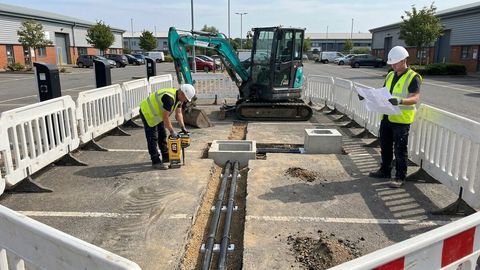
Adding EV charging to an existing car park: the civils side
For rapid EV charging in an occupied car park, the connection and civil works can drive cost and programme. What estate managers should plan first.
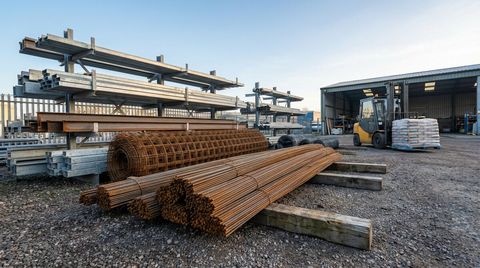
Steel surcharges, blocked straits, and your next tender: construction costs in 2026
Material costs are up 37% since 2020 and steel surcharges hit 30% in March. Practical guidance for contractors and project managers pricing work in a volatile market.

How civil engineering projects actually get managed: what subcontractors need to get right
A practical guide to managing groundworks and civil engineering projects in the UK. Programmes, procurement, variation control, and the things that actually cause overruns on site.